

Competitor analysis
Turn knowledge into advantage
Identify trends and market gaps. Build a stronger business strategy on competitive insights, not imitation.
What is competitor analysis?
Competitor analysis is the process of evaluating the market to understand your rivals, see how you compare, and spot risks and opportunities. This involves examining competitors, their products, pricing, or strategy, but also external factors like technology, trends, or regulations that may affect your business. As a result, you can make better, informed decisions.
There are many competitive analysis frameworks to choose from, each with its own focus and purpose. Diagrams and charts are an essential part of every method, presenting market and competition insights in a visual, accessible way.
Competitor analysis frameworks
Let's use an example: you're building a simple, open-source productivity tool for remote agile teams. Which method should you choose to learn more about the market?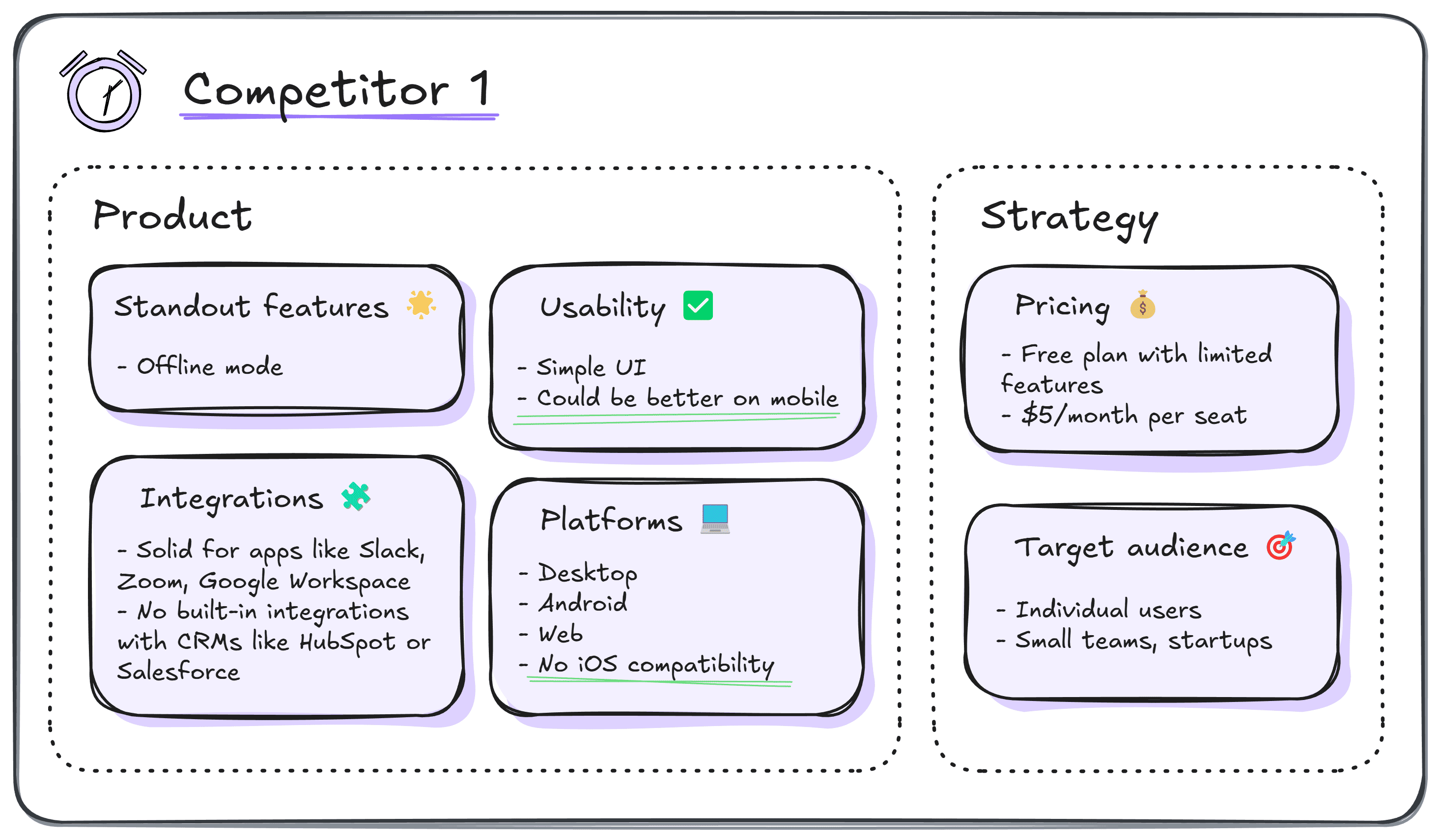
Competitor profile
A competitor profile is a simple chart that covers each rival’s key details, like pricing, features, target users, strengths, and weaknesses.
For our productivity app, this could include competitors' standout product features, integrations, usability, or subscription tiers.
When to use it
Use this framework early in your research to understand each main competitor individually before moving to more detailed comparisons. Focus on two to four key rivals and keep the profiles brief and easy to scan.
Competitive matrix
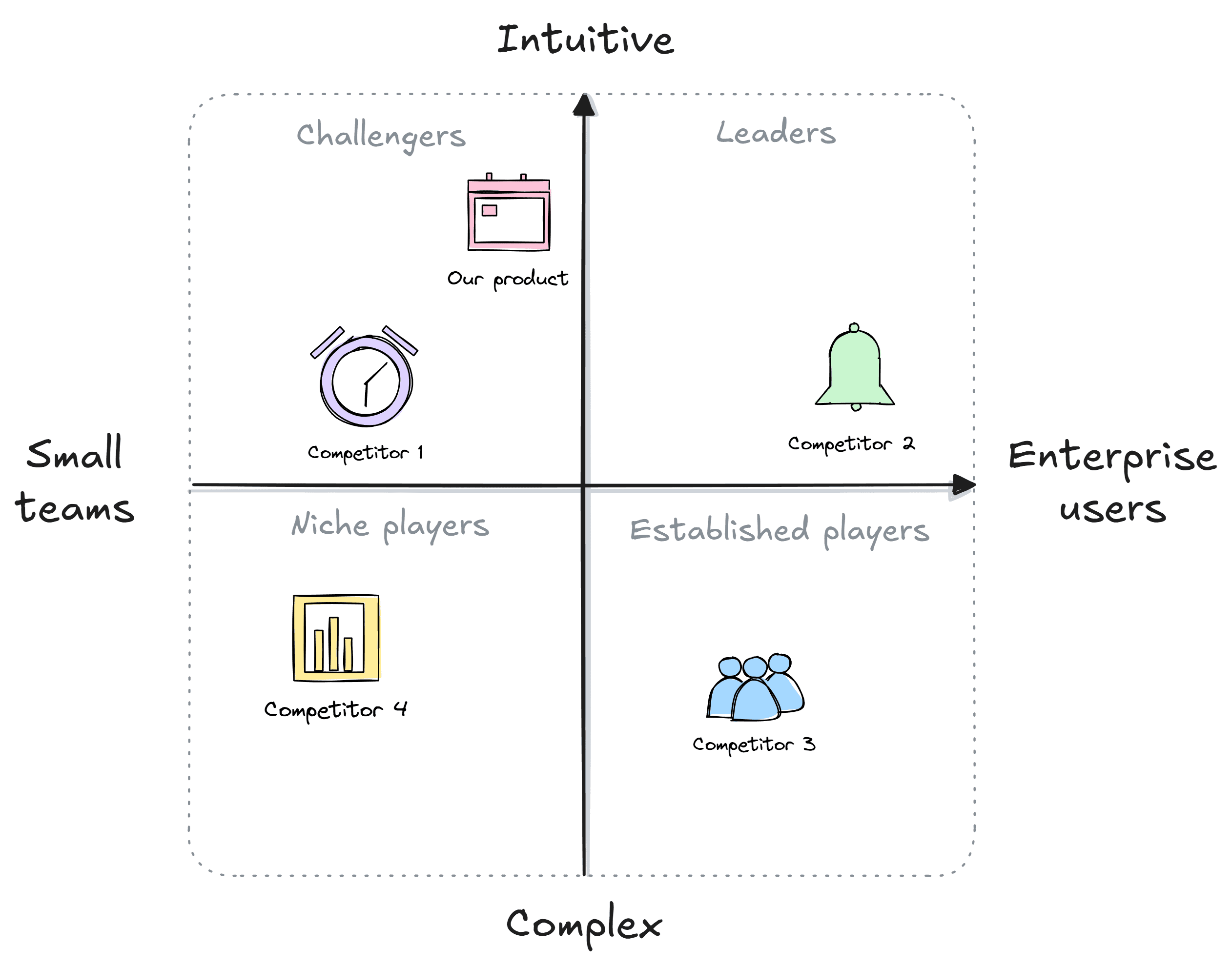
By positioning your competitors on this two-axis chart, you can quickly compare them across two main factors, such as pricing, complexity, or features.
In our example, this could mean mapping similar productivity tools based on the learning curve versus target audience fit to see where our platform stands in the market.
When to use it
Apply it to entire companies, products, or even specific features to get a quick overview of the market. To make the division clearer, you can label each part of the graph, e.g., "leaders" for the top right quadrant and "challengers" for the top left.
Radar chart
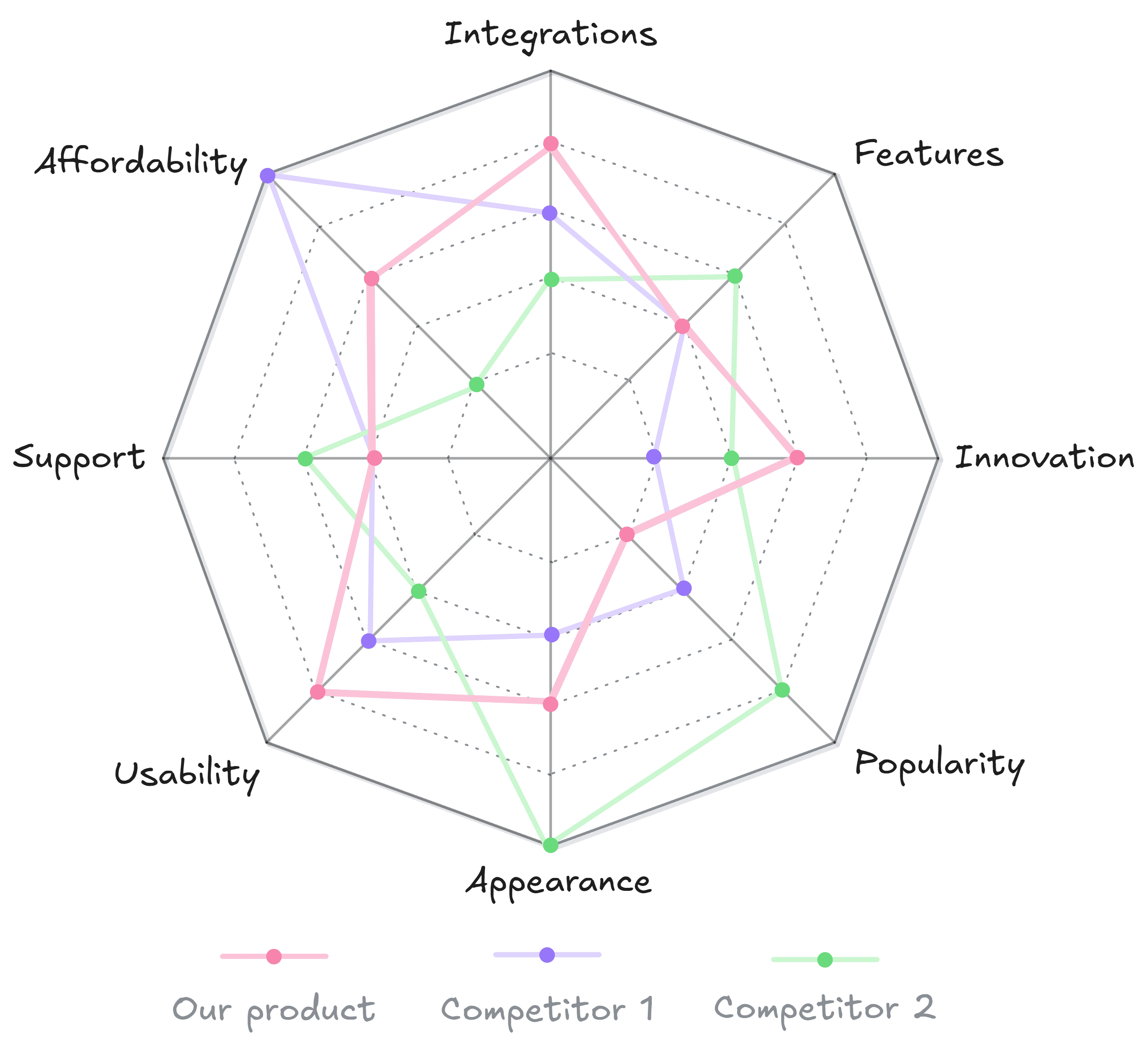
A radar chart (or spider chart) allows you to compare competitors across several key factors at once. For our app, these factors could include pricing, integrations, usability, or support.
Each competitor is rated on a scale (e.g., 1–5) marked with dots. Connecting them forms a visual profile showing how you and your competitors stack up.
When to use it
With multiple criteria and a point-based scale, this method is more nuanced than a competitive matrix. Keep it simple—narrow it down to your main rivals so the graph stays legible and focused.
Porter's Five Forces
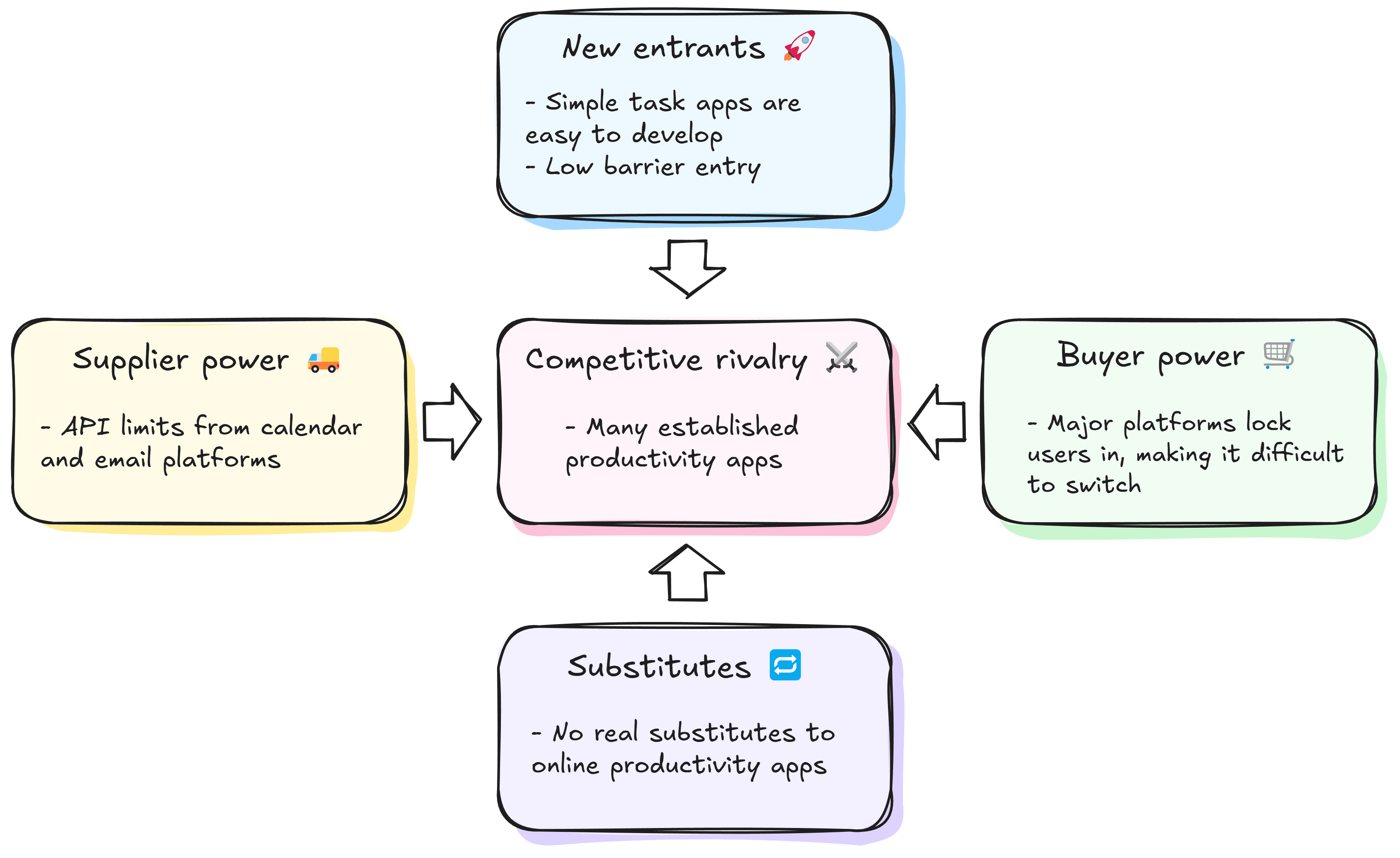
This framework looks at five key forces—supplier power, buyer power, new entrants, substitutes, and competitive rivalry—to show where you face the most pressure and where you can strengthen your market position.
In the productivity app market, buyer power would be limited, as the biggest platforms try to lock users in by preventing data transfers or using proprietary file formats. This creates an opportunity for us to stand out by offering more flexibility through our open-source approach.
When to use it
Porter's approach goes beyond your competition, giving you additional context for understanding the market. It’s versatile and useful whether you’re exploring a new niche or analyzing your current one.
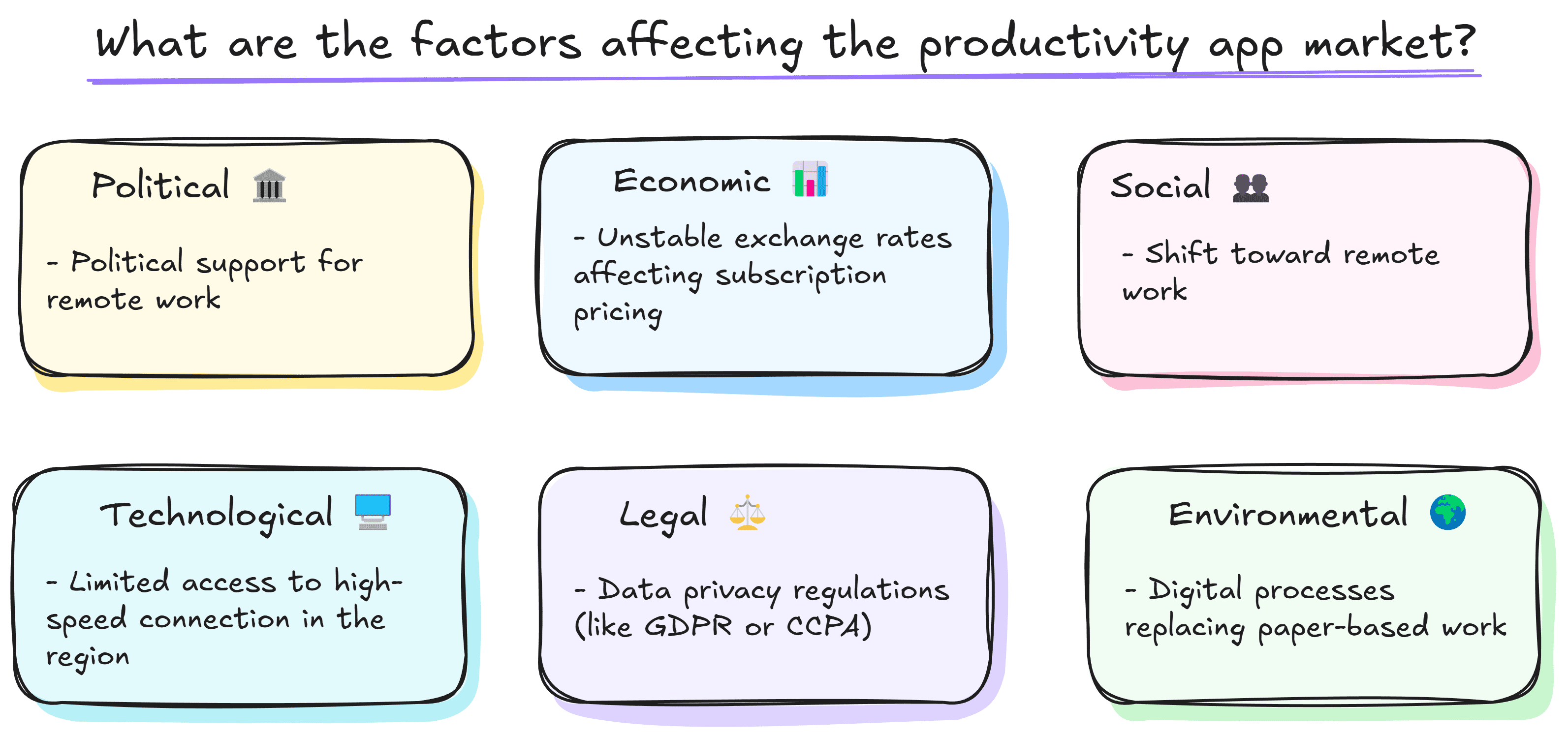
PESTLE analysis
PESTLE analysis helps assess how Political, Economic, Social, Technological, Legal, and Environmental factors can affect your market.
In our example, these factors might include data privacy regulations, rising demand for remote collaboration, or limited access to high-speed internet in the target region.
When to use it
Use this method alongside competitor-focused frameworks to get a more complete perspective of the market that accounts for both the competition and external factors.
PESTLE analysis will also help you spot risks and opportunities when entering a new market or launching new features.
.png)
ERRC grid
An ERRC grid helps you create a unique value proposition by identifying what to Eliminate, Reduce, Raise, or Create.
In the case of our productivity app, this means eliminating UI clutter, reducing setup time, raising task visibility, and creating new ways to integrate third-party tools.
When to use it
It's the perfect way to sum up the outcomes of your competitive analysis and list action points for your next steps.
The ERRC framework also ties neatly into the blue ocean strategy, clearly showing what you should focus on to differentiate your product and deliver more value to customers.
How can specific professions use competitor analysis?
Business Executives
Spot market gaps and benchmark performance to guide strategy and investment. Compare competitors' pricing to refine your own model and track their product expansion to plan your roadmap.
Product Managers
See which features matter most in the market and where user expectations are shifting. Refine your product's roadmap by focusing on underserved pain points and unique features.
Marketers
Understand market trends to find new promotion opportunities. Adjust messaging based on competitors' shortcomings and your own strengths. Highlight how you can solve problems that your rivals can't.
Sales Representatives
Know competitors' offerings, pricing, and positioning to create stronger sales pitches. Show the advantages of your product to win deals and answer customer questions with confidence.
Tips and tricks for competitor analysis
Best practices for competitor analysis
- Keep diagrams clear: Don’t overcrowd your charts—use short labels and key metrics. For instance, instead of full sentences, rate each app’s “usability” or “pricing flexibility” on a 1-5 scale.
- Mix different methods: Each framework has its use—combine them to get the complete picture. Use PESTLE to analyze external factors and a radar chart for detailed feature comparisons.
- Don't wait for perfect data: Your own knowledge of the market is often enough to create a solid, actionable overview. Use available records and feedback to verify your assumptions and avoid bias, not as the foundation of your competitive analysis.
- Don't obsess over competitors: Apply the findings to get better, not to follow your rivals blindly. For example, if others emphasize integrations, focus on making them faster or more seamless instead of just adding more.
Creating visual competitor analysis in Excalidraw
- Stay consistent: Keep visuals uniform across all analyses. For example, assign each competitor a specific color (like red) and use it consistently in charts, notes, and comments related to them.
- Use grid and snapping: Right-click on the whiteboard and select "Snap to objects" or "Toggle grid" to draw complex charts like spider diagrams with precision.
- Use shortcuts: Press R or 2 to draw a rectangle, A or 5 to draw an arrow, and T or 8 to create a text box. Press ? to explore all shortcuts.
- Create with libraries and templates: Browse Excalidraw libraries for icons, components, and shapes, or open a new scene with an editable competitive analysis template to visualize your research clearly. Note: The scene opens in the free editor. You'll be able to save or export your current work before loading the scene.

Wrapping up
Competitor analysis helps you spot your rivals' strengths and gaps, evaluate performance, and understand their strategies. By combining different methods, you can use competitive analysis to see the bigger picture: not just your competitors, but your customers, trends, the market, and where your own business stands.
With that knowledge, you can make informed decisions. Refine your positioning, spot opportunities for growth, create a unique offering, and avoid risks, all based on analysis, not guesswork.


Business use or teamwork? Try PLUS features
💬 Comments: Collaborate seamlessly by sharing feedback and ideas directly on your competitive analysis templates.
🎙️ Voice hangouts and screenshare: Run live competitive analysis sessions fully in Excalidraw, without extra tools.
📺 Presentations: Quickly transform your competitor analysis boards into polished, shareable slides for team alignment.
😎 Unlimited scenes: Create any number of dedicated boards for specific competitor segments or comparisons by different criteria.
📂 Work organization: Make collaboration easier with scene collections, user accounts, access controls, and team workspaces.
Sources and further reading
Some of the frameworks we listed here have remained the industry standard for competitor analysis and business planning for decades. Check out these resources to learn how they were invented, how they evolved, and how to apply them.
Eliminate-Reduce-Raise-Create (ERRC) grid
A simple tool developed by Chan Kim and Renée Mauborgne as an essential tool in their blue ocean strategy framework.
How Competitive Forces Shape Strategy
The original article by Michael E. Porter that explains in depth how his method plays into a larger business strategy.
Scanning the business environment (book)
Francis J. Aguilar's introduction to the PEST framework that later evolved into PESTLE analysis.
